

Forgiveness does not automatically restore trust, reopen contact or require reconciliation. You can explore what forgiveness means to you while keeping limits around money, privacy, visits or a relationship that has ended.
Treat these as separate choices. Your faith or spiritual practice may support reflection, while your safety and freedom to decide still matter.
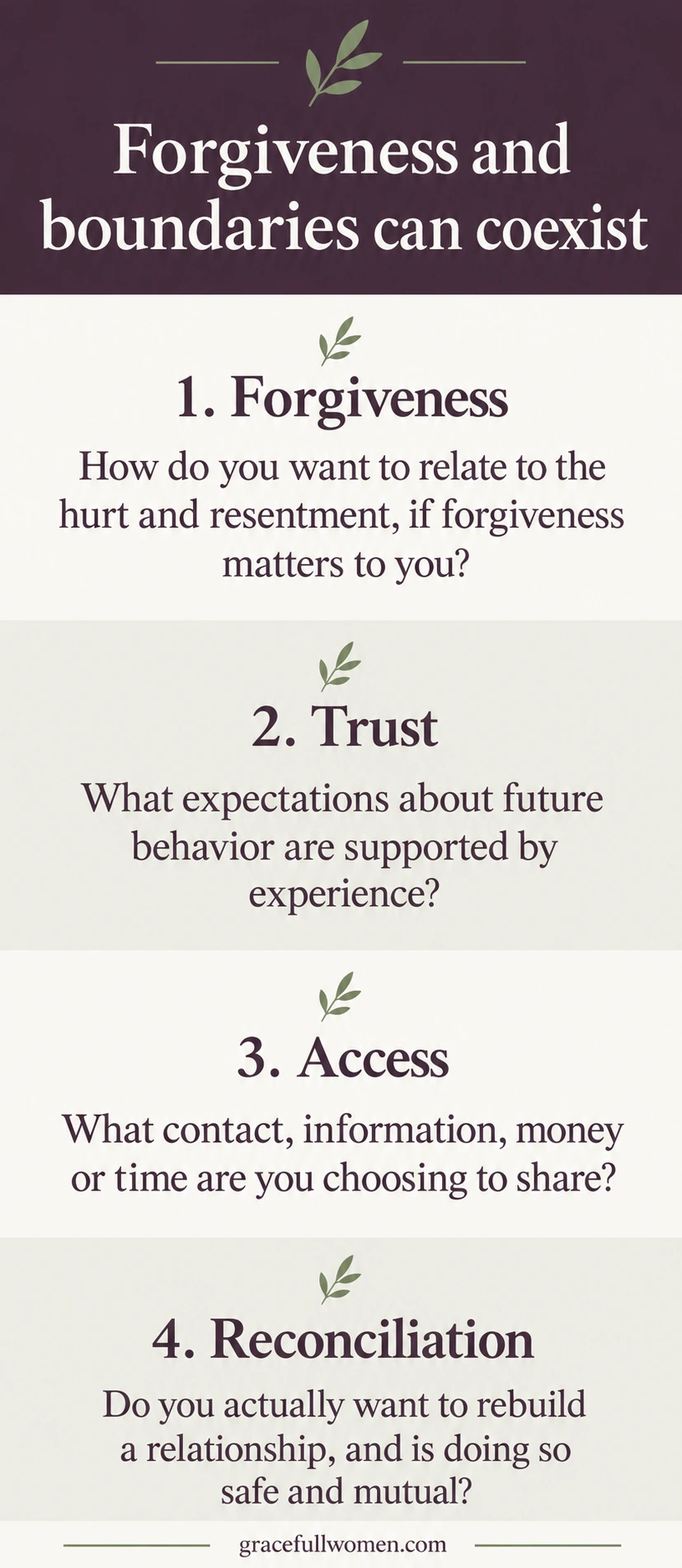
Four decisions that do not have to move together
Read the guide as text
- Forgiveness. How do you want to relate to the hurt and resentment, if forgiveness matters to you?
- Trust. What expectations about future behavior are supported by experience?
- Access. What contact, information, money or time are you choosing to share?
- Reconciliation. Do you actually want to rebuild a relationship, and is doing so safe and mutual?
Considering Your Decisions
Look at forgiveness, trust, access, and reconciliation as separate things. Forgiveness can mean that you change your relationship with resentment, and trust means that your expectations are set about future behaviors. Access can mean that you give privileges such as visits, shared money, or private information, and reconciliation can mean that you rebuild some form of the relationship.
Someone can decide one thing without changing the others. You might decide that you no longer want to spend the evenings replaying what your sister said to you, but you keep your financial details private. You might accept an apology from someone but wait to see if their behavior really changes.
Mayo Clinic distinguishes forgiveness from excusing harm or necessarily reconciling. This is a useful starting point, rather than a requirement to feel a certain way.
You can do a little exercise by writing down four boxes on a page and writing what you currently want in each. You can say something like, "I want less mental stress," or "I don't want private visits with them." You can look at these decisions separately to get rid of the pressure of making one big choice.
Protecting Boundaries
A good boundary looks at the problem and asks what's been affected, such as physical safety, money, privacy, time, or energy. Then you pick an action that protects these things.
If a relative is always sharing your private news, the boundary might involve sharing less information with them. If a friend is always canceling plans at the last minute, you might stop buying non-refundable tickets on their behalf.
Don't pick some big consequence just to prove that you're serious about what you say. The best kind of boundary is one that you can maintain and that fits the behavior that's being done.
Talk About Your Actions without Controlling Others
A good boundary means that you say what you're going to do. You can say something like, "If the conversation is insulting, then I end the call." This gives you a chance to make a practical response. Don't say, "You can never get angry with me," to try to control someone else's emotion.
You can always ask someone to change their behavior, such as saying, "Please don't talk about my body." This is a boundary that explains the reason for setting it. If the request is ignored, you can say, "If you keep doing it, then I'm going to end the conversation."

Keep the action you propose possible. If you can't safely leave a home, then don't build a plan around doing so when you're fighting. Consider other kinds of support and options.
Assertive communication is direct and honest while respecting each person’s rights. Clear wording can support that aim, although wording alone cannot make an unwilling person respectful.
Don’t Respond to Guilt Right Away
Even if you set a good boundary, sometimes guilt might show up. You might have learned that being loving means you're always available, or that family conflict has to stay hidden. A new limit can feel scary before it feels natural.
Ask yourself if you violated a value or disappointed expectations. These aren't the same thing. Breaking a commitment might mean you need to say you're sorry, but declining an unreasonable demand can mean you tolerate the discomfort if it shows up.
Take time to pause before you change a boundary. Write down the reasons you're changing it and then look at the facts. Has a situation changed, or has the other person's reaction made it harder for you to keep a decision?
You don't have to be indifferent if you get disappointed. You can pay attention to the disappointment and acknowledge it by saying something like, "I understand that you wanted me there, but I'm still not available." Being compassionate can help to change your tone without meaning that you have to change your decision.
Don’t Go for Revenge
A good limit reduces harm and preserves your capacity. Revenge causes someone to suffer, and the two can get tangled if you get hurt. Make sure you look at the purpose of the action you're taking.
For example, a financial boundary after unauthorised spending may aim to protect access to money. Get appropriate advice before changing shared financial arrangements. Posting private details online can be humiliating and can cause new harm and risks without making the protection stronger.
This doesn't mean you have to be calm or feel kind to set a boundary. Anger can show you a violation, and you can use the information while you decide how to respond to it.
Ask what you would do if nobody said you made the right decision and the other person never admitted that you're right. This question can show whether the action is supporting your life. A boundary needs to stay useful even when it doesn't mean you get an apology, feel regret, or recognize something you wanted.
Set Boundaries When Family Members Get Involved
Sometimes family members might encourage you to forgive someone or repair a relationship because they miss having everyone together. Maybe they want family gatherings to feel normal again, or they're simply tired of the tension. But just because they're uncomfortable with the situation doesn't mean they understand everything that happened or get to decide whether you're ready to reconnect.
It can help to have a simple response ready when someone brings up the subject. You might say, "I'm dealing with this privately right now, and I'd appreciate it if you didn't try to arrange a meeting or pass messages between us." You don't have to explain every detail of what happened or defend your decision each time someone asks.
If you're worried about running into the person at a family gathering, consider asking someone you trust to help with the arrangements. For example, they might be able to help you plan separate arrival times or let you know who will be attending. Try asking for something specific instead of expecting them to convince everyone that your decision is right.
But if someone continues ignoring your boundaries, it might be necessary to limit what you share with them, too. Maybe you decide to ask who's attending an event before agreeing to go, or you wait until plans are confirmed before sharing your own schedule.
Remember that protecting your privacy doesn't mean you have to convince every family member to take your side. Sometimes finding a quieter way to handle the situation is better than trying to get everyone to understand or agree with your decision.
Let Your Faith Support Your Decisions
For some people, forgiveness is closely connected to their faith, spiritual beliefs, or family traditions. Prayer, religious teachings, and personal spiritual practices can bring comfort during difficult times and help people think about how they want to move forward. These beliefs can be meaningful parts of someone's healing process.
But your faith should never be used as a reason to pressure you into returning to a harmful situation or accepting behavior that makes you feel unsafe. Be careful if someone tells you that being a good person or a faithful believer means you have to reconnect with someone who hurts you, accept physical affection you don't want, or avoid getting professional help.
If you're struggling with how forgiveness fits into your beliefs, consider talking with a spiritual adviser you trust. You might ask something like, "How can I stay true to my faith while still keeping the boundaries I need?" This gives you an opportunity to explore your beliefs without assuming that repairing the relationship is the only acceptable decision.
Fear and Abuse in Relationships
Ordinary advice about stating a limit assumes it is safe to do so. Threats, monitoring, financial control or forced sexual contact call for specialist support and safety planning.
If you're in any of these situations, the first thing you need is safety planning and support. You don't have to talk about a new rule or explain your forgiveness. There are domestic abuse advocates who can help you consider options that fit your situation.
In the United States, the National Domestic Violence Hotline can be reached at 800-799-7233 or by texting START to 88788. Use a safer device if your communications may be monitored. Outside the United States, seek a local specialist service; contact local emergency services if there is immediate danger.
Abuse is the responsibility of the person doing it. Fear, wanting distance or declining reconciliation do not mean that you are failing to recover. No emotional milestone gives another person permission to abuse you.
If you share responsibilities, separate the tasks from personal access. You can answer a brief message about getting your belongings without talking about the relationship. You can arrange a handover for your child through a third party when it's safe and lawful. Cooperating on one task doesn't open the door to conversations, and a kind exchange doesn't erase boundaries that you've set.
Make a Review and Not a Verdict
Some boundaries should stay forever, and others can be reviewed when the situation changes. You can pick a review point without promising that you're going to change your boundaries. If you've had repeated unwanted visits, you might only accept a planned daytime meeting in public for now. Later on, in a few months, you can ask whether the arrangement works well for your well-being. The review can confirm that you need to keep the boundary.
You can ask if you want longer visits or if you trust the person. Making a small decision doesn't change the whole relationship. You can also decide that looking at the contact over and over again is exhausting and not look at it for a while. Closure doesn't always come with a final conversation, and sometimes it happens through ordinary days when your time, attention, and choices are completely about you.
Taking the Right Actions
You can ask yourself what happened before, why it matters, and what you need to protect now. If the answer is no right now, then this information is useful. You don't have to invent conditions to make your boundaries seem fair.
Wanting limited contact doesn't mean that you're confused or weak, and forgiveness can stay unfinished. Trust can be partial, and affection can continue with distance. Human relationships can have more than one truth at one time.
Pick an action step that shows your position instead of the position of other people and how they want you to act. This might mean that you accept an apology, refuse an invitation, or get the support that you need. You can take action with care and keep the distance that you choose.
Separate forgiveness from access
Choose the decision that needs more clarity for prompts about what you want to allow now.
If contact brings fear, threats or retaliation, consider private specialist support before attempting a joint conversation.
Use the questions and examples in the article above; the draft builder needs JavaScript.
15 questions readers ask
1. Does forgiveness mean reconciliation?
No. Forgiveness and rebuilding a relationship are separate choices. Reconciliation may be unwanted, unavailable or unsafe.
2. Does an apology restore trust immediately?
No. Trust concerns expectations about future behavior and can depend on what happens over time. Accepting an apology does not require immediate confidence.
3. Can I forgive while limiting contact?
Yes. You can explore forgiveness while retaining limits on visits, messages, money or private information.
4. Do I have to forgive to move forward?
You do not have to meet another person’s forgiveness deadline or definition. Support can focus on your needs and recovery without requiring renewed access.
5. What is the difference between a boundary and revenge?
A boundary aims to protect your safety, privacy, resources or capacity. An action aimed primarily at humiliation or suffering may create further harm without improving protection.
6. Can a boundary describe my own action?
Yes. For example, you might end an insulting call or stop sharing news that is repeatedly passed on. Choose an action that is realistic and safe for you.
7. Can I ask someone to change their behavior?
Yes. Make the request clear, while recognising that you cannot control their response. Consider what you will do if the pattern continues.
8. What if I feel guilty after setting a limit?
Ask whether you broke a commitment or are uncomfortable with someone’s disappointment. The feeling alone does not establish that the limit is wrong.
9. Should I explain until everyone agrees?
You can keep an explanation brief. A boundary does not require unanimous approval, and repeatedly debating it may not provide useful information.
10. How can I respond to family pressure?
State what you are handling privately and what you do not want relatives to arrange or pass on. Share only what is useful and safe.
11. Can spiritual beliefs support boundaries?
Yes. Faith, prayer or spiritual reflection can coexist with practical limits. Beliefs should not be used to pressure you into unwanted contact or prevent professional support.
12. What if someone says forgiveness requires trusting them?
You can reject that condition. Forgiveness, trust, access and reconciliation can be considered independently.
13. Does necessary practical contact reopen the relationship?
Not automatically. A lawful arrangement about belongings, children or another responsibility can remain separate from personal conversations and emotional access.
14. Must a review date lead to more contact?
No. Reviewing a boundary can confirm that you want to keep it. You can also decide not to revisit the question repeatedly.
15. What if stating a boundary could provoke harm?
Seek private specialist guidance and safety planning through a safer channel. You do not have to announce a new rule or discuss forgiveness before asking for support.